

The way AI is designed directly impacts safety, accuracy, and trust in pharmacy
Written by Brad Crosslin and Aaron Cunningham
Artificial intelligence is rapidly reshaping how pharmacies engage with patients. From handling refill requests to answering medication questions, AI promises faster, more convenient interactions at scale.
But not all AI is created equal.
Many of today’s AI tools are designed to be flexible and open ended, capable of answering virtually any question. While that versatility may work in general consumer settings, it introduces real risk in a pharmacy environment, where accuracy, privacy, and trust are non-negotiable.
The Problem with Open or Agentic AI in Pharmacy
Consider a simple but telling example.
A pharmacy AI assistant is asked for a sourdough bread recipe. Instead of declining, it responds with a full recipe, despite having nothing to do with pharmacy care. At first glance, this may seem harmless. But it reveals a deeper issue common in open or agentic AI systems: the AI is operating outside its intended scope, pulling from uncontrolled sources, and generating responses that are not grounded in verified pharmacy data.
Unconstrained or “agentic” AI systems are often given broad access to data and tools, with minimal oversight. They can decide when to retrieve information, what to share, and how to act. In some cases, this has led to serious failures, such as AI systems taking unintended actions without confirmation or validation.
In a pharmacy setting, that same behavior could lead to:
- Inaccurate or misleading medication information
- Exposure of sensitive patient data
- Responses that fall outside compliance boundaries
- Erosion of patient trust
Industry frameworks like the National Institute of Standards and Technology (NIST) AI Risk Management Framework highlight the need for controlled data sources, defined system boundaries, and reliable outputs in regulated environments1.
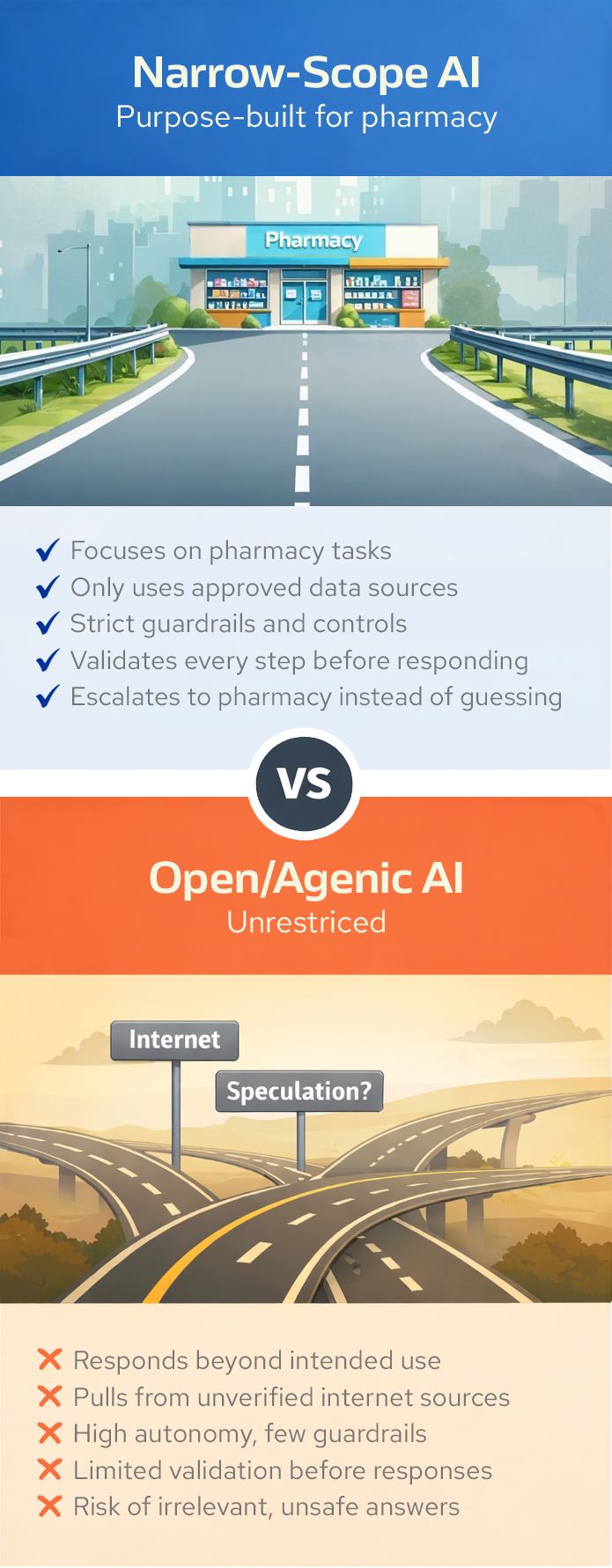
A Different Approach: Narrow-Scoped AI
At Synerio, we take a fundamentally different approach.
Instead of building open or agentic AI systems, we design narrow-scoped AI, purpose built to handle specific pharmacy related tasks and nothing more. This is not a limitation. It is a requirement for safety, compliance, and trust.
Designing AI this way is not easy. It requires deep domain expertise, rigorous validation, and a commitment to getting it right from the start. Synerio’s narrow-scoped approach was not added later. It is foundational to how the system was built from day one.
Synerio’s narrow-scoped AI is built with rigorous controls and validation at every layer, ensuring responses are accurate, secure, and constrained to approved pharmacy use cases. Here’s why our approach is right for pharmacy:
- Defined scope of knowledge
The AI only responds to pharmacy related questions. If a request falls outside that scope, it does not attempt to answer. It declines and redirects the patient to ask about pharmacy topics only. - Grounded in approved data sources
The AI translates patient questions into accurate, conversational answers that are grounded in verified sources, including pharmacy management systems, pharmacy-defined content, and clinical drug databases such as First Databank and Medi-Span. It does not browse the internet or pull from unverified sources. - Validated, trustworthy outputs
The AI does not speculate or generate unsupported answers. When a question cannot be answered with reliably based on approved sources, the AI will decline to answer or escalate the request to the pharmacy team. - Continuous learning through the Answer Hub
The system captures unanswered questions, allowing pharmacy staff to add approved responses that are automatically used for future patient interactions. - Deterministic where it matters most
For critical, high-risk scenarios, such as emergency situations or pharmacy-specific policies, the system delivers exact, pre-approved responses with no variation. - Real time processing, no data retention
Patient data is processed within the context of the interaction. It is not stored, retained, or used to train AI models. Information is processed in real time, within a HIPAA compliant and SOC 2 secure environment, ensuring patient privacy is never compromised. - Validated actions and guardrails
Every request and response is evaluated against strict rules to ensure it aligns with the intended task and authorized data access. Unlike open or “agentic” AI systems, it is not given unchecked access to data or external tools.
These principles align with guidance from the Food and Drug Administration on trustworthy AI in patient facing systems, as well as HIPAA privacy and security expectations enforced by the Office for Civil Rights2.
Why Focus Builds Trust
In pharmacy, trust is everything.
Patients expect accurate information, consistent experiences, and confidence that their personal data is protected. Open or agentic AI systems, by design, cannot guarantee these outcomes. Narrow-scoped AI can. By limiting what the AI can do, pharmacies gain confidence in what it will do, every time. That consistency protects both the patient experience and the pharmacy’s brand.
Research from organizations like Healthcare Information and Management Systems Society and McKinsey & Company reinforces that trust, transparency, and governance are critical to successful AI adoption in healthcare adjacent industries3 4.
The Bottom Line
AI has enormous potential to improve pharmacy operations and patient engagement. But in a regulated, high trust environment, how that AI is designed matters just as much as what it can do.
Narrow-scoped AI represents a more responsible path forward, one that prioritizes accuracy, protects patient data, and ensures every interaction stays within the boundaries of safe pharmacy care.
At Synerio, we believe the future of AI in pharmacy is not about doing more. It is about doing the right things, safely, consistently, and with purpose.
Questions Every Pharmacy Should Ask AI Vendors
The answers to these questions will quickly reveal whether an AI solution is built for convenience or for safe, compliant patient care.
As AI adoption accelerates, pharmacy leaders should look beyond surface level capabilities and ask deeper questions about how these systems are designed:
- What data sources does the AI use to generate responses?
- Is the AI designed as an open or agentic system, or is it constrained to a defined scope?
- How does the AI handle questions it cannot confidently answer?
- Is patient data stored, retained, or used for model training?
- Are responses validated against approved content before being delivered?
- During the demo, ask the AI assistant for a sourdough recipe and observe how it responds to an out of scope request.
Sources
1 National Institute of Standards and Technology, “AI Risk Management Framework”
2 Healthcare Information and Management Systems Society. “Navigating the Regulatory Landscape: An Analysis of Legal and Ethical Oversight for Large Language Models (LLMs).”, March 24, 2024.
3 Healthcare Information and Management Systems Society. “AI Global Policy Principles.”, Accessed April 12, 2026.
4 McKinsey & Company. “Generative AI in healthcare: Current trends and future outlook.”, March 26, 2025. | “Healing consumer confidence through AI-powered, human-centered healthcare.”, February 19, 2026.
About the Authors
Brad Crosslin, Synerio Senior Vice President of Retail Pharmacy Products and Services, brings decades of pharmacy and technology expertise. Beginning his career as a pharmacy technician and rising to president of PDX, he’s known for visionary product leadership that always puts patients first.
Aaron Cunningham, Synerio’s Chief Architect, is a pharmacy technology leader and AI expert with deep expertise in designing and delivering scalable solutions for pharmacies.
About Synerio
Always at the forefront of AI and other advanced technologies, Synerio crafts pharmacy solutions to drive pharmacy efficiency and exceptional patient experiences. With a legacy of pharmacy innovation, Synerio uses AI to streamline both patient engagement and pharmacy operations. Our solutions make it easy for patients and pharmacy teams to get the support they need anytime. From reducing complexity behind the counter to delivering faster, more personalized care, Synerio helps create a smarter, more efficient pharmacy experience with technology that feels effortlessly human.